
GUIDES
Retail data systems: the stack behind a modern retailer
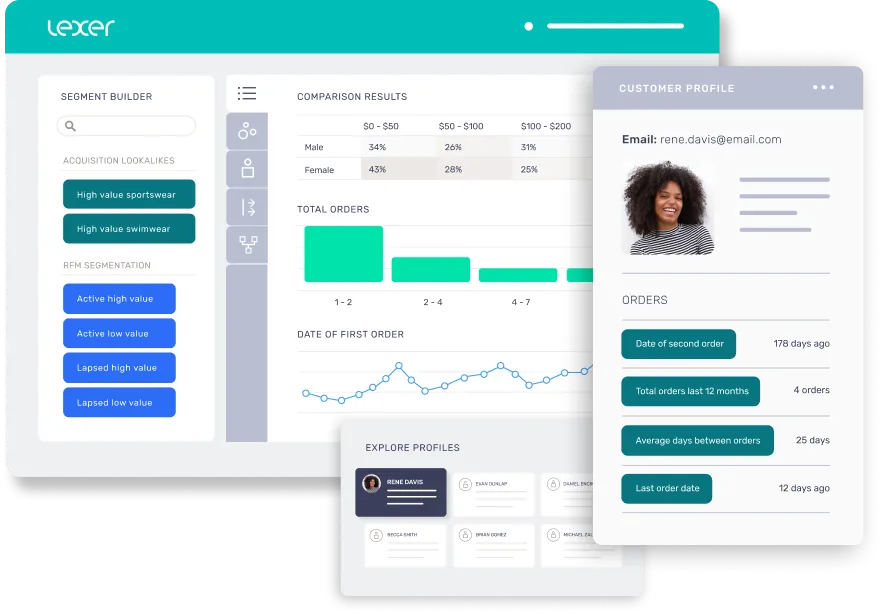
A retail data system is any system that captures, stores or moves the data a retailer runs on: point of sale, ecommerce, merchandising, inventory, loyalty, marketing, service and reporting. The term retail information system means broadly the same thing and is the older phrasing, more common in academic and enterprise contexts.
The eight retail data systems
Point of sale (POS). Every in-store transaction, at line item level.
Ecommerce platform. Online orders, accounts, browsing behaviour, carts.
Enterprise resource planning or merchandising. Product master, cost, supplier, purchase orders.
Inventory and warehouse management. Stock by location, movement, replenishment.
Loyalty. Membership, points, tier.
Marketing automation. Sends, opens, clicks, subscribers.
Service and returns. Tickets, complaints, returns history.Small volume, high signal, almost always disconnected.
Business intelligence and reporting. Whatever has been modelled into it.
How they fit together
Read that list again and the gap is obvious. Two systems hold transactions, one holds cost, one holds identity, and none of them holds a customer.
This represents a common structural problem in retail data, as every system is organised around a thing: an order, a product, a location, a send. Only a customer data platform is organised around a person, which is why the customer layer usually has to be added rather than found.
The second structural problem is cost. Product cost sits in the merchandising or enterprise resource planning system and rarely reaches the marketing side. Without it, every customer value calculation runs on revenue, and revenue ranks discount-dependent customers as highly as full-price ones.
Building or buying the customer layer
Warehouse plus modelling plus reverse ETL. This process can be completed using products like Snowflake or BigQuery, dbt, or a tool such as Hightouch. These tools give maximum control, full ownership of the logic, and need engineering to build and engineering to change, meaning that every new segment goes into a queue.
Enterprise customer data platform. Tools like Segment, Tealium, mParticle, Amperity. Enterprise CDPs enable Identity resolution at scale, and are built for technical teams. They commonly take 12 to 18 months before onboarding and implementation is complete, and retail interpretation is left to you.
Retail customer data platform. POS ingestion, loyalty matching, product hierarchies and margin are usually already in the product. These CPDs are narrower by design, faster to value, and less flexible if your requirements are unusual.
Where Lexi fits
Lexi sits as the customer layer across the stack rather than replacing anything in it.
Lexi ingests transactions, inventory, POS, loyalty, reviews and signals, resolves identity across all of them, and holds product cost alongside the order so margin per customer becomes available rather than theoretical. The systems you already run keep doing what they do. Lexi joins them at the customer.
Then anyone can use it. Ask in plain language, get an answer built from the resolved data with the calculation shown, then build the segment and push it back out to the tools your team already runs. No SQL, no ticket, no analyst queue.
Lexi runs inside AWS Bedrock, data never leaves the platform, no personally identifiable information enters AI processing, and Lexer is SOC 2 certified.
An audit worth running first
Before evaluating anything, map what you have. Six questions, one afternoon.
- Which systems hold a customer record, and how many records does each hold?
- What share of point of sale transactions carry a customer identifier?
- Where does product cost live, and what would it take to get it into the marketing side?
- Which connections between systems are automated, and which are someone exporting a file?
- Who owns each connection?
- What does each system say your total customer count is, and why do the numbers differ?
Related Articles
📄 Customer Data Platform (CDP)
📄 Retail Customer Data Platform
📄 Customer Intelligence Platform
📄 Customer Segmentation Matrix
📄 Customer Experience in Retail