
September 3, 2021
|
6
minute read
AI-powered retention signals: how to stop churn before it happens




Customer retention is a prediction problem. The customers who are about to leave rarely announce their departure. They just quietly stop buying. AI-powered retention signals give you the ability to see that behaviour before it becomes a lost customer, and act while there's still time.
This article covers five ways AI signals improve retention in retail: from predicting churn risk to identifying your highest-value customers and timing your outreach to match actual buying behaviour.
What are AI-powered retention signals?
AI-powered retention signals are behavioural patterns and data-derived scores that indicate how likely a customer is to buy again, lapse, or churn. Unlike static reports that tell you what already happened, retention signals are forward-looking: they use machine learning to analyse purchase history, engagement patterns, and customer attributes to predict what a customer is likely to do next.
For retail marketers, the most useful retention signals include:
- Churn risk score: The probability that a customer will not return within a defined window
- Predicted lifetime value (CLV): The total revenue a customer is expected to generate over their relationship with your brand
- Next best action: The product, offer, or channel most likely to prompt a repeat purchase
- Days since last purchase: When combined with category-level purchase frequency norms, a leading indicator of lapse
- Engagement decline: Falling email open rates, reduced site visits, or lower app activity before a visible purchase gap
These signals are most powerful when they're built from unified customer data: in-store and online transactions, loyalty programme activity, email engagement, and service interactions, all resolved into a single customer profile.
Why retention deserves more attention than it gets
The economics are not subtle. A 5% improvement in customer retention can increase profits by 25 to 95%, according to Bain & Company research. At the same time, acquiring a new customer now costs five to 25 times more than retaining an existing one, with average acquisition costs having risen 222% over the past five years (Envive, 2025).
For most retailers, existing customers already represent the majority of revenue. Existing customers are 50% more likely to try new products and spend 31% more than first-time buyers (Affinco, 2026). The challenge is knowing which customers are at risk before they leave, not after.
That's where AI changes the calculus. Retail businesses using AI-powered predictive analytics for churn prevention see up to a 2.9x revenue increase compared to those relying on reactive retention strategies (Affinco, 2026).
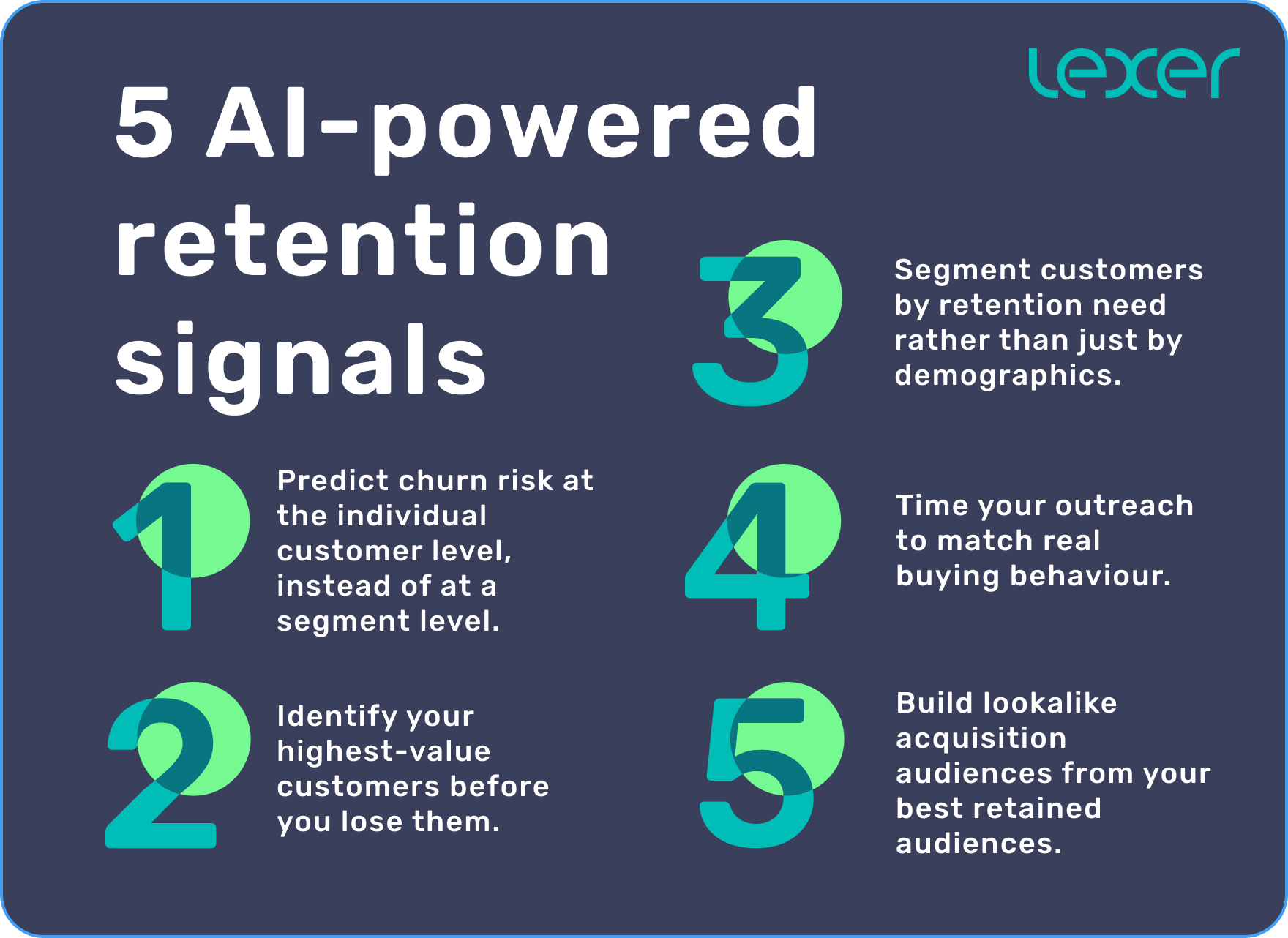
1. Predict churn risk at the individual customer level
Most retention programmes use broad rules, "any customer who hasn't bought in 90 days gets a win-back email", because that's what's practical without predictive scoring. The problem is that a 90-day gap means very different things depending on the customer. A customer who typically buys every six months is not churning. A customer who used to buy every three weeks and hasn't bought in six weeks probably is.
AI-powered churn risk scores account for this variation. By analysing each customer's historical purchase frequency, category behaviour, and engagement patterns, a churn model can calculate the probability of lapse for each individual.
The practical result: you can prioritise your retention spend on the customers who need it most, rather than blasting your entire database with discounts. High-risk, high-value customers get proactive, personalised outreach. Low-risk customers get left alone (which protects your margin and your brand credibility).
For retail specifically, churn prediction is complicated by the fact that consumers go through a cool-down period before fully lapsing. Miss that window and win-back becomes exponentially harder. AI-powered churn scoring helps you identify that window before it closes.
2. Identify your highest-value customers before you lose them
Not all at-risk customers are worth the same intervention. A customer in the top 20% of your database by lifetime value, who also shows early churn signals, is a very different priority from a one-time buyer showing the same signals.
Predicted customer lifetime value (CLV) gives you that lens. By modelling future purchase behaviour from historical data, you can rank your at-risk customers by their expected contribution to your business. This does two things:
- It focuses your retention investment where it has the highest ROI
- It helps you design the right intervention e.g., a VIP experience or personalised offer for a high-CLV customer, a lighter-touch reminder for someone with lower predicted value
The broader principle is well-established. Most retail businesses find that a small proportion of their customers drive the majority of revenue, a pattern reflected in the Pareto principle. But the insight only becomes actionable when you can calculate who that top tier actually is, predict which new customers have the potential to reach it, and identify which existing top customers are showing early signs of disengagement.
3. Segment customers by retention need, not just by demographics
Retention is not one problem. Some customers need a product recommendation. Some need a timing nudge. Some are at risk because they had a poor experience. Some are loyal but under-engaged with categories they'd actually buy if you surfaced them correctly.
AI-powered signals let you segment your customer base by retention need rather than just by demographics or historical spend. Useful retention-focused segments include:
- Customers with high predicted CLV and rising churn risk: prioritise for proactive outreach
- Customers who have purchased in one category but not adjacent categories they're likely to enjoy: cross-sell opportunity
- Customers who lapsed after a first purchase: second purchase conversion is the most important retention milestone
- Customers with high engagement but low recent purchase frequency: something changed; worth investigating
- Customers who are addressable by email and those who are not: affects which channels you can use for re-engagement
When segments are built on predictive signals rather than static attributes, they stay current as customer behaviour evolves. A customer who was low-risk three months ago and is now showing churn signals will move into the right segment automatically, rather than staying in a cohort defined by their last manual segmentation run.
4. Time your outreach to match real buying behaviour
One of the most underused AI retention signals is repurchase timing prediction.
For categories with natural replenishment cycles (skincare, supplements, pet food), this is intuitive. But it applies across retail more broadly than most marketers realise. A customer who bought running shoes eight months ago and typically buys new footwear annually is likely entering their purchase window. A customer who tends to buy in the two weeks after payday shows a timing pattern you can act on.
When you time outreach to match predicted purchase readiness, you see better conversion rates, lower unsubscribe rates, and less brand fatigue. You're reaching customers when they're already inclined to buy, not interrupting them when they're not.
This timing signal is particularly powerful for driving second purchases. The window immediately after a first purchase, sometimes called the "buyer's high" period, is when the probability of a repeat purchase is highest. After a first purchase, there's roughly a 27% chance a customer returns. After a second purchase, the probability of a third purchase jumps to 54% (Envive, 2025). Getting timing right at this critical juncture has a compounding effect on lifetime value.
Automated post-purchase communications, when personalised and timed correctly, reduce 90-day churn by 14% and drive 45% higher second-purchase rates for first-time buyers (Marketing LTB via Envive, 2025).
5. Build lookalike acquisition audiences from your best retained customers
Once you've identified your highest-value, highest-retention customers through predictive CLV modelling, you can use those profiles to build lookalike acquisition audiences. Rather than targeting broadly and hoping you attract customers who'll stick around, you focus acquisition spend on prospects who match the behavioural and demographic profile of customers you've already proven you can retain.
This closes the loop between retention and acquisition. Your retention data directly informs your acquisition targeting, which improves both acquisition efficiency and long-term retention rates by attracting better-fit customers from the start.
In practice, this means building lookalike audiences from your top retention segments and using those audiences in paid media campaigns across channels like Meta and Google. The quality of the input determines the quality of the output, which is why unified customer profiles that combine in-store and online data produce more accurate lookalike models than online-only data.
For an example of this in practice, Rip Curl used Lexer's customer segmentation to identify high-value customer profiles and build targeted acquisition campaigns, achieving a 220% improvement in ROAS while staying within budget.
What you need to make AI retention signals work
AI retention signals are only as good as the data they're built on. Before investing in predictive models, it's worth checking whether you have the foundations in place:
Unified customer data. If your in-store and online transaction data lives in separate systems, your churn models will be incomplete. A customer who buys in-store after not buying online is not churning — but you'll misclassify them if your data is siloed. Identity resolution connects customer records across channels into a single profile, which is the prerequisite for accurate retention scoring.
Sufficient transaction history. Predictive models need historical data to learn from. For most retail businesses, 12 to 24 months of clean transaction data is the minimum viable starting point.
Activation capability. Signals without action don't improve retention. You need to be able to act on churn risk scores, CLV tiers, and timing predictions, either through your CRM, email platform, or paid media channels. The closer your analytics and activation capabilities are integrated, the faster you can move from signal to campaign.
FAQs
What are AI-powered retention signals in retail?
AI-powered retention signals are data-derived scores and behavioural indicators, such as churn risk, predicted lifetime value, and repurchase timing, that help retailers identify which customers are at risk of lapsing and when to intervene. They're generated by machine learning models trained on historical purchase, engagement, and behavioural data.
How does predictive analytics improve customer retention?
Predictive analytics improves customer retention by identifying at-risk customers before they leave, prioritising retention effort by customer value, and timing outreach to match actual buying behaviour. Businesses using AI-based churn prevention see up to a 2.9x revenue increase compared to reactive-only approaches.
What is a customer churn risk score?
A churn risk score is a predictive metric, typically expressed as a probability between 0 and 1 or as a tier (low, medium, high), that indicates how likely an individual customer is to stop purchasing within a defined time window. It's calculated from historical purchase frequency, category behaviour, and engagement patterns.
What is customer lifetime value (CLV) and why does it matter for retention?
Customer lifetime value is the total revenue a customer is predicted to generate over their entire relationship with your brand. It matters for retention because it lets you prioritise where to invest: a high-CLV customer showing churn signals warrants a very different response than a low-value one-time buyer in the same situation.